We use cookies to ensure that we give you the best experience on our website.
PEPLINK · BRIEFLY EXPLAINED
What does SpeedFusion do?
SpeedFusion uses several suitable internet connections within a shared VPN tunnel. The three functions serve different purposes:
Bandwidth Bonding – use the bandwidth of multiple WAN connections for a shared data stream.
WAN Smoothing – send redundant packets to reduce the effects of packet loss and jitter. This requires additional bandwidth.
Hot Failover – preserve ongoing sessions through the remaining tunnel paths when a connection fails.
This requires compatible routers, a reachable endpoint, suitable WAN connections and the required features or licences. Uninterrupted availability is not guaranteed.
Low-orbit satellites shorten the radio path compared with geostationary systems. LEO satellite internet can support interactive applications and add another access path to business connectivity.
<2,000 km
LEO orbital altitude
Shorter paths
Radio path compared with GEO
Networked
Satellite constellation
Definition: LEO satellite technology (Low Earth Orbit) refers to technology in low Earth orbits at altitudes below 2,000 km. For satellite internet, multiple satellites work together in a constellation. One example is Starlink and its LEO constellation. Access can operate without a local fixed-line or mobile connection, but remains dependent on the satellite provider's operational infrastructure.
The comparison
LEO and GEO: orbit and latency
Geostationary satellites (GEO) orbit at an altitude of around 35,786 km and appear stationary from Earth. LEO satellites move in much lower orbits. The shorter radio path reduces signal propagation time and can make video conferencing, VPN connections and cloud applications easier compared with GEO. However, actual end-to-end latency also depends on routing, network utilisation and the onward path to the destination server; it cannot be inferred from orbital altitude alone. As LEO satellites move across the sky, regular handovers between satellites are part of normal operation. Achievable performance must be assessed for the location, service and application.
Resilience
LEO as backup: benefits and limitations
A LEO connection can provide an additional, differently routed access path and reduce reliance on local cable and mobile networks. Operation requires a suitable installation with a clear view of the sky, power for the terminal and network equipment, regional service availability and an appropriate service plan and support package. The provider’s satellite, ground station and internet interconnection infrastructure must also remain operational. During a regional power outage, the connection can only continue to be used if local backup power is sufficient and the satellite service remains reachable. Weather, obstructions or provider outages can still cause interruptions; LEO is not immune to failure. wirelessmaxx supports preventive connectivity and resilience needs, including those of hospitals, utilities and energy organisations. Its sister company Hypria is intended to address operational deployment needs for fire services, THW and other aid and emergency response organisations. This internal division of services is not an official critical infrastructure classification or a statutory protection priority.
Netze im Überblick
LEO-Satelliteninternet: Starlink, Eutelsat OneWeb und Amazon Leo
Starlink von SpaceX ist das derzeit größte LEO-Netz und in Deutschland mit Starlink Business für Unternehmen verfügbar. wirelessmaxx bietet Starlink-Terminals ausschließlich mit Tarif und Service an.
Eutelsat OneWeb betreibt nach Angaben von Eutelsat mehr als 600 Satelliten in zwölf Bahnebenen in rund 1.200 km Höhe. Das Netz richtet sich vor allem an Unternehmens-, Behörden-, See- und Luftfahrtkunden und wird über Servicepartner vermarktet.
Amazon Leo (ehemals Project Kuiper) befindet sich im Aufbau; Amazon nennt Deutschland unter den ersten Märkten. Verfügbarkeit, Terminals und Tarife für Unternehmen sind noch nicht abschließend bekannt.
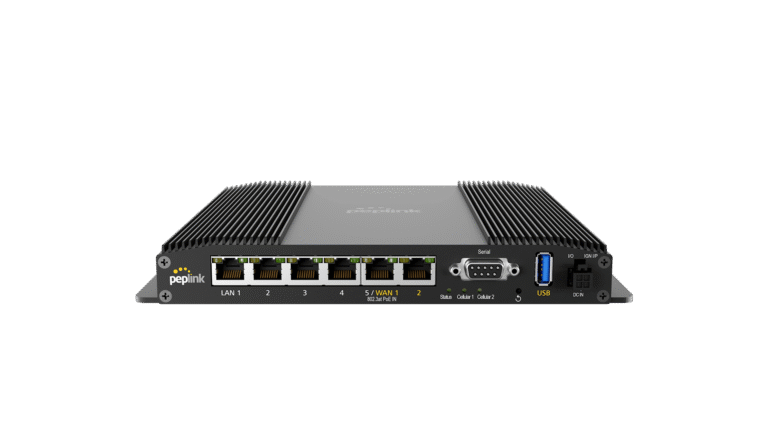
Für Unternehmen und KRITIS-nahe Standorte kann eine Multi-Orbit-Planung sinnvoll sein, bei der mehrere Satelliten- und Mobilfunkwege kombiniert werden. Multi-Orbit-fähige Router wie der Peplink MAX Orbit unterstützen Ethernet-basierte Satellitenverbindungen verschiedener Netze. Wie Satelliteninternet als Backup bei einem Internetausfall eingesetzt wird, zeigt die Seite Ausfallsicheres Internet.
Integration
Integration into the business network
wirelessmaxx plans the integration of LEO connections into corporate IT via suitable Peplink WAN interfaces. How Starlink can be integrated into the corporate network using Peplink depends on the router, connections and applications. An appropriately configured SpeedFusion VPN tunnel with AES-256 encrypts data between the local Peplink router and the chosen remote endpoint, such as another Peplink router or FusionHub. Encryption in transit alone does not guarantee data sovereignty; remote endpoints, access rights and subsequent data processing must also be assessed. Failover or bonding require suitable additional connection paths, appropriate features and a coordinated configuration; SpeedFusion requires a reachable remote endpoint. This allows LEO to be considered for remote sites or as a backup, without promising blanket equivalence to fibre or uninterrupted operation.
The right network solution for your project?
With connecting.works GO we start with your connectivity needs and clarify suitable access options, network integration and support. Starlink terminals are offered exclusively with a tariff and service; the specific scope of service is agreed before implementation.