We use cookies to ensure that we give you the best experience on our website.
PEPLINK · BRIEFLY EXPLAINED
What does SpeedFusion do?
SpeedFusion uses several suitable internet connections within a shared VPN tunnel. The three functions serve different purposes:
Bandwidth Bonding – use the bandwidth of multiple WAN connections for a shared data stream.
WAN Smoothing – send redundant packets to reduce the effects of packet loss and jitter. This requires additional bandwidth.
Hot Failover – preserve ongoing sessions through the remaining tunnel paths when a connection fails.
This requires compatible routers, a reachable endpoint, suitable WAN connections and the required features or licences. Uninterrupted availability is not guaranteed.
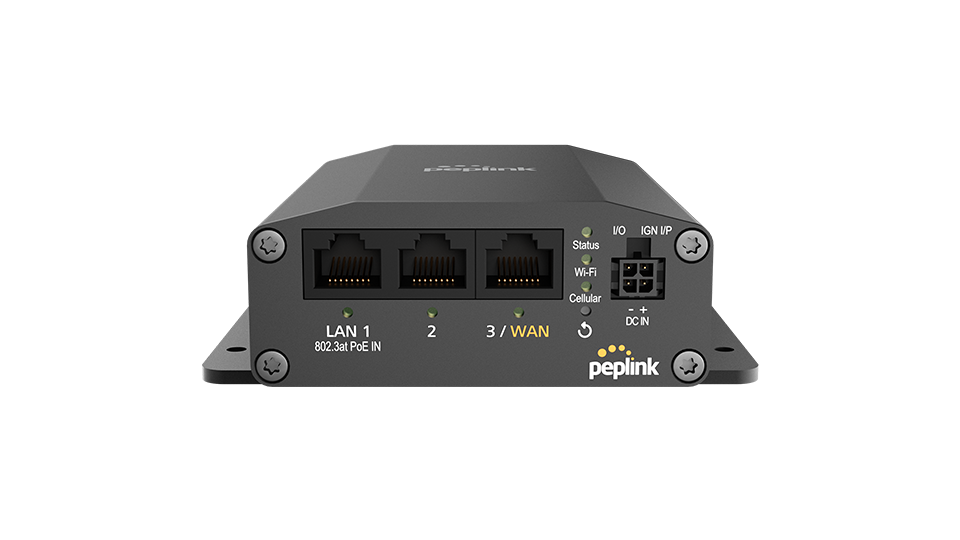
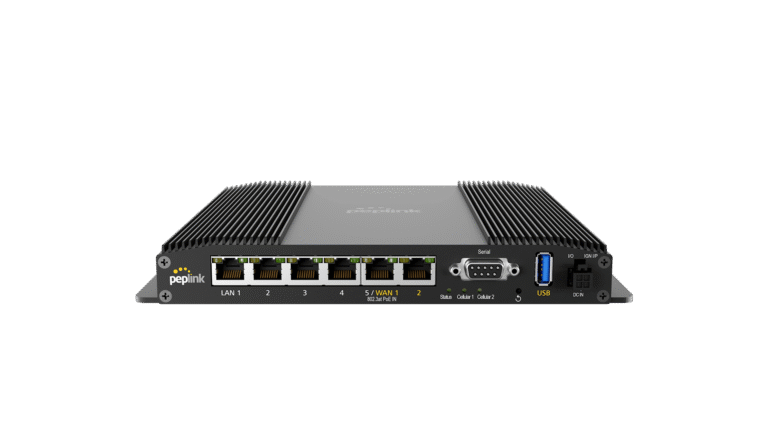
A 5G Router is a router with an integrated or connected 5G modem that provides internet access for local networks over a mobile connection. The FCC describes 5G as the fifth generation of mobile communications, promising faster data rates, lower latency and greater network capacity. [1] Peplink describes its 5G routers as systems for robust connectivity between people, businesses and objects, citing applications such as teleoperation, broadcasting, branch offices, healthcare and manufacturing. [2]
Definition: A 5G router connects devices, sites or vehicles to the internet over a 5G mobile network and, depending on the model, can serve as a primary connection, backup link or part of a Multi-WAN architecture for the network.
5G router use cases and planning
For businesses, 5G is particularly useful when fixed-line connections are unavailable, too slow or insufficiently resilient. A 5G router can serve as a temporary primary connection on a construction site, keep a branch online if its fixed-line connection fails, or add mobile redundancy to a Starlink setup. During a fixed-line outage, this requires a mobile connection that is still available, a working power supply and correctly configured failover. 5G also requires suitable network coverage, support for the relevant frequency bands, a sensible antenna position and a suitable data plan.
Use case
5G router role
Planning factor
Branch backup
Backup connection if fibre, DSL or cable service fails.
Failover logic, data allowance, antenna position.
Temporary site
Primary internet connection for a construction site, event or pop-up shop.
Network coverage, power supply, mounting, external antenna.
Vehicle or mobile unit
Internet access for routers, cameras, tablets, IoT or operational systems.
Vibration resistance, power supply, roof antenna, GPS.
Starlink complement
Mobile redundancy during satellite connection interruptions.
Multi-WAN rules, prioritisation, cost control.
Site networking
WAN link for VPN or SD-WAN.
Latency, provider, NAT, SpeedFusion options.
5G mobile networks are not 5 GHz Wi-Fi
The FCC points out that 5G requires compatible devices and appropriate networks, and that 5G must not be confused with the 5-GHz frequency band of a Wi-Fi router. [1] This distinction matters when communicating with customers, because “5G” used as a Wi-Fi label means something different from 5G mobile communications.